
You Have To Laugh, Or Else You’ll Cry
Working in healthcare affords me many opportunities to experiences the joys and tragedies of people’s lives. I have been there when people are born, and I have been there when people die. I have hugged a family member when their loved one was yelling at them irrationally because of their terminal condition. I have washed the feet of the meanest old ladies I have ever met.
Inappropriate Laughter
In these moments of service and compassion, I often find myself laughing at moments that from the outside may seem inappropriate or perhaps even run or disrespectful. I understand that. I do. Surely if I were to care for someone, and they noticed me giggle about something that was in no way funny, I would likely be offended, but the nature of this profession causes a forced oddity in humor.
That’s not to say that I laugh at people or problems. I have the utmost respect for my patients, their care, and the dignity that the deserve. I give it and give it well. There is nothing funny about someone’s medical condition. However, there are times that I have found humor striking situations or events because of the complete absurdity of it all.
Overheard During a Code
It’s not uncommon to hear nurses making jokes or talking about completely unrelated topics during a code blue. It’s a coping mechanism. It’s not that they do not respect the patient or the crisis, but if we actually stopped to think about the fact that life is in our hands, then we would not be nearly as efficient at our roles. We would not be good nurses because our emotions would get the best of us, and we may get scared, intimidated, or even break down. This is one of the main reasons why many feel that family need not be present in a code situation. Also the fact that it is not a memory of their loved one that they need to have, they may misinterpret the conversation and actions exhibited by healthcare providers. These wonderful, talented and passionate individuals, whom normally wouldn’t spout a smidgen of profanity, suddenly become sailors with the most colorfully graphic language imaginable.
There are some that argue that family members have the right to be in the room during a code (CPR: cardiopulmonary resuscitation) for closure purposes. I agree. If you feel strongly that you need to be there and to experience their death for your grieving process, I encourage you to advocate to stay. But I do so with a warning to you that the image of your loved one as 10 members of a medical team poke, probe, pounce, and almost beat the crap out of them are not the memories you want of loved one, whether or no. This is no an occasion to stand up for your family member and demand the best care. This is an occasion to step back and let the team do their best to save Uncle John’s life. If you have a problem with the way care is or has been delivered I strongly encourage you to advocate for your loved one, but please let us stabilize them first.
Why A Nurse Ask You To Step Out
To those of you who are nurses, you understand why we ask the family members to step out of the room. To those who are not, I want to ask you to understand kindly that it is for your benefit. I promise your loved one will receive the best care from us possible, but it would be a much less awkward for the both of us if you would step outside while we try to save your family member’s life. And if you happen to hear an off-color remark, a laugh in the middle of these tragic moments of chaos, I apologize on behalf of my profession. But sometimes, when we need it most, God sends us the courage to fulfill our duties in creative ways. Know that we respect you, your loved one, and our healthcare. Know that we put our hearts and souls on the line to provide your care and sometimes you just have to laugh or else you will cry.
And sometimes I do cry.
Download Nurse Bingo Today!
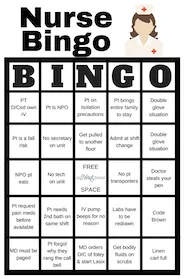
Liven up any shift with a fun game of bingo. See who can fill a row first!
Fill a whole card and lose grip with reality.
Your privacy is protected. We will never spam you.



If a nurse told you to step out, there’s a good reason for it.
Eloquently said! As a nurse, I have laughed and joked through many codes and laughed even harder
afterwards, even if the patient died. You’re exactly right, we mean no disrepect at all, it’s our way of lessening the pain of our own emotions…it’s either laugh or cry. We have to let it out in some way…release the pressure of it all…and more often than not, that pressure can be immense. We DO NOT want to carry that home with us, to our own families…we have to release it during work hours.
So please, as Nerdy Nurse said, do not ever take offense at our giggles and laughter or off handed comments, it’s benign, totally.
And yes, if you need to be present when you’re loved one is bein worked on such as during a Code situtation, kindly observe at the door. With 10+ nurses, respiratory therapists and doctors in the room hopping around the bed, you may get knocked over or delay things by seconds that could be imperitive to your family members care. Taking 1-2 seconds to say, “excuse me” so we can get around you makes all the difference at times. Seriously, it would be better for you…not to observe this situation…unless you feel you absolutely must.
Thanks in advance, for your understand.
Exactly!
Thanks so much for your comment.
I understand that some people feel the need to be present, but they definitely need a disclaimer.
Hey Brittney, Thanks for elaborating the nurse side of the story. I now realize how difficult it is for nurses to be in a hospital room and remain calm at the same time. From all my past hospital experiences, I in fact have enjoyed the ‘nurse humor’ in the room. It has helped me take my mind off the serious situation. Your post got me asking myself: aren’t nurses the heart of healthcare? They have to be the support the doctors need in emergency situations and always help comfort the patients. They need to be alert all the time and deal with each task sensibly. They have to have a fine balance between feeling compassion for a loss of life and suffering of a patient at the same time not letting that compassion turn into hopelessness. No wonder they are called as ‘angels in comfortable shoes’ 🙂 Thanks for sharing this.
We are pumped to have you on Livefyre! Glad to be a part of your community!
Thank you for the lovely comment! It looks pretty nice so far.
Can’t wait to see the comment luv style feature be implemented.